
Click Here to Explore
Why You Really Hurt
It All Starts in the foot
by Dr. Burton S. Shuler

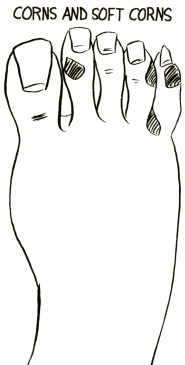
 Corns are thickening of the
skin created by Mother Nature,
in order to insulate and protect
the toes against abnormal friction and bony
pressure in our shoes.
They can be located on the top of
any of the toes, or in between
the toes. The corns that form between
the toes or in the toe webs is called
"soft corns" and appears most often in between the 4th and 5th toes. Soft corns are primarily
caused by perspiration that collects
between the toes, and since this
moisture is always present, the
corn tissue does not have an
opportunity to harden. Corns are thickening of the
skin created by Mother Nature,
in order to insulate and protect
the toes against abnormal friction and bony
pressure in our shoes.
They can be located on the top of
any of the toes, or in between
the toes. The corns that form between
the toes or in the toe webs is called
"soft corns" and appears most often in between the 4th and 5th toes. Soft corns are primarily
caused by perspiration that collects
between the toes, and since this
moisture is always present, the
corn tissue does not have an
opportunity to harden.
 These abnormal bony pressures
are most commonly caused by
bone spurs of the toes, Arthritis or
a Hammer Toe condition. A
Morton's Toe
either directly or indirectly can cause a hammer toe. The reason's that corns hurt
are due to the irritation of the skin, nerves and other tissues that are being
constantly rubbed by the abnormal bone,
when it is in a shoe. In many cases there
is a related Bursitis of the toe. This is
an inflammation of the fluid contain
sac that covers, and protects the
toe.Many people attempt to treat corns
themselves with over-the counter
medicines. These medications
contain acid and while they may
dissolve the corn tissue, they
do nothing to get rid of the
underlying bone problems,
and can be very dangerous especially
if the person is a Diabetic or has
poor circulation.Another popular self-treatment is
"bathroom surgery" or "trimming
of the corn", but like the acid
all that this does is to
temporarily remove the corn
tissue without treating the real
problem of the bone. I feel it
is extremely dangerous to do this
bathroom surgery since thousand
of people a year lose their toes, feet,
legs, and life as a direct result
of it.The good news is this vicious
cycle, can be avoided for this chronic
condition. I am pleased to advise there
are a number of ambulatory techniques
that can be performed in an office setting
to alleviate the painful corn. One
such technique involves making
a tiny incision into the skin after
the area has been anesthetized,
and then slipping down to the bone
with special instruments to
smooth out a little bump or
permanently removing the bony
spur. Afterwards, we put a small bandage
on it, and after the patient has
put his shoe back on, he is free to
resume most of his normal activities.
Hospital-based surgery is not
necessary to fix this problem, and can
easily be ina office, through the utilization of ambulatory surgery
But do not forget, it could be the untreated Morton's Toe
that is the real cause of your corns.
These abnormal bony pressures
are most commonly caused by
bone spurs of the toes, Arthritis or
a Hammer Toe condition. A
Morton's Toe
either directly or indirectly can cause a hammer toe. The reason's that corns hurt
are due to the irritation of the skin, nerves and other tissues that are being
constantly rubbed by the abnormal bone,
when it is in a shoe. In many cases there
is a related Bursitis of the toe. This is
an inflammation of the fluid contain
sac that covers, and protects the
toe.Many people attempt to treat corns
themselves with over-the counter
medicines. These medications
contain acid and while they may
dissolve the corn tissue, they
do nothing to get rid of the
underlying bone problems,
and can be very dangerous especially
if the person is a Diabetic or has
poor circulation.Another popular self-treatment is
"bathroom surgery" or "trimming
of the corn", but like the acid
all that this does is to
temporarily remove the corn
tissue without treating the real
problem of the bone. I feel it
is extremely dangerous to do this
bathroom surgery since thousand
of people a year lose their toes, feet,
legs, and life as a direct result
of it.The good news is this vicious
cycle, can be avoided for this chronic
condition. I am pleased to advise there
are a number of ambulatory techniques
that can be performed in an office setting
to alleviate the painful corn. One
such technique involves making
a tiny incision into the skin after
the area has been anesthetized,
and then slipping down to the bone
with special instruments to
smooth out a little bump or
permanently removing the bony
spur. Afterwards, we put a small bandage
on it, and after the patient has
put his shoe back on, he is free to
resume most of his normal activities.
Hospital-based surgery is not
necessary to fix this problem, and can
easily be ina office, through the utilization of ambulatory surgery
But do not forget, it could be the untreated Morton's Toe
that is the real cause of your corns.
|
© 1982-2010, Dr. Burton S. Schuler, all rights reserved